
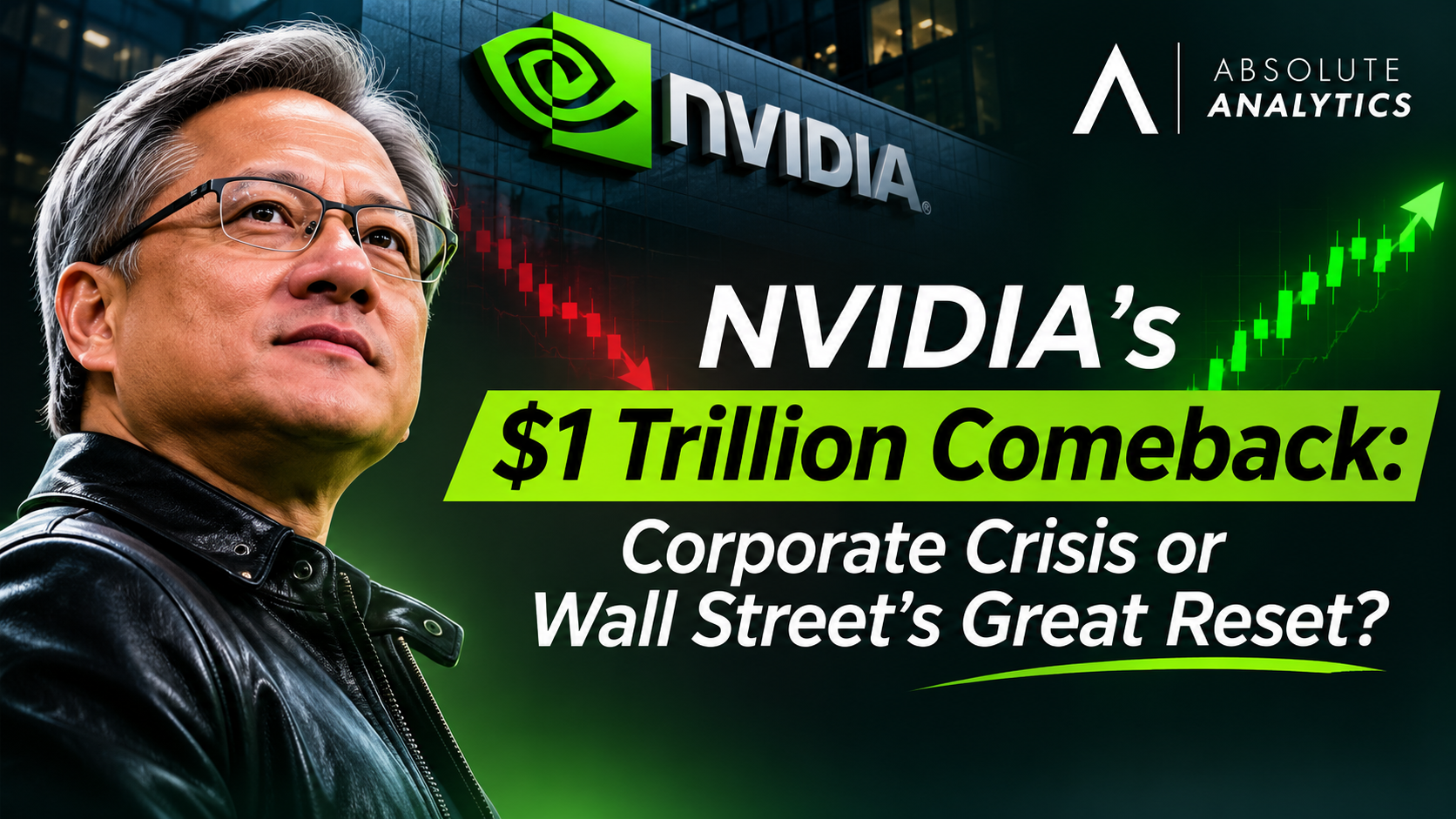
An affair. A resignation. A boardroom reversal. And nearly $1 trillion in market value restored in a single trading session. Quite a sequence, isn't it?
While the world remains fascinated by Jensen Huang's personal controversy, I find the financial implications of NVIDIA's dramatic collapse and recovery far more interesting.
Perhaps what is happening behind the curtain deserves more attention than what is visible on the stage.
Could this extraordinary episode have created the perfect opportunity for institutional investors to restructure their positions?
The problem with a stock that never stops rising!
The AI boom transformed NVIDIA into one of the most valuable companies in history. Investors rushed madly to participate, expectations soared, and early investors accumulated enormous paper profits.
And the financial growth was remarkable.
Consider NVIDIA's latest quarterly results, announced on 17 November:
Revenue: $115.8 billion, up 103% YoY.
Net profit: $65.3 billion, up 105% YoY.
Data centre revenue: $107.6 billion, up 110% YoY.
Gross profit margin: 74.8%.
Next-quarter revenue guidance: $130 billion.
Here was a company doubling its revenue and profits compared to the previous year, yet experiencing a dramatic stock market correction.
But think about it from the perspective of a large institutional investor.
When everyone is bullish, it can be an attractive environment to reduce exposure. When everyone is frightened, it can become an attractive environment to accumulate.
Makes sense?
The challenge is finding sufficient liquidity and favourable valuations. A major negative news event can change that equation almost overnight!
I am not saying that is what happened here, but the possibility deserves examination.
A resignation, a rejection and a remarkable reversal.
Let's look at the sequence of events.
12 November: NVIDIA announced Huang's resignation following revelations about his personal conduct.
17 November: Its board publicly ruled out his return and was pursuing a permanent replacement.
22 November: Just five days later, the board unanimously approved his reinstatement following discussions involving senior US government officials.
23 November: NVIDIA shares surged approximately 31.48%, closing at $165.05.
Nearly $1 trillion in market value was restored in a single session.
The S&P 500 and Nasdaq also rallied sharply, demonstrating how deeply NVIDIA's fortunes are intertwined with the broader AI investment cycle.
What makes this particularly interesting is that the company's independent investigation has not yet concluded.
The founder returned to his chair. Investor confidence recovered. But important underlying questions remain unanswered.
The $227 billion detail that caught my attention.
Amid all this noise, there is another number worth looking at.
$227.3 billion.
That is the amount remaining under NVIDIA's share repurchase authorisation at the end of its latest quarter.
In September itself, NVIDIA's board had approved an additional $150 billion for share repurchases.
Now, let's do some simple mathematics.
Imagine NVIDIA deploys $10 billion towards buying back its own shares.
At $200 per share, it can purchase 50 million shares.
At $150 per share, it can purchase approximately 66.7 million shares.
At $125 per share, it can purchase 80 million shares.
The same capital buys 60% more shares at $125 than at $200.
Interesting, isn't it?
A falling share price can create considerable financial advantages for a cash-rich company and prospective long-term investors, provided the underlying business remains strong.
Of course, an authorised buyback is not an executed buyback. We do not yet know how much NVIDIA actually repurchased during this particular correction.
That is something worth tracking in its subsequent disclosures.
Someone turned $2,700 into nearly $47,000
Now this is where the story gets even more interesting.
According to blockchain analytics firm Bubblemaps, as reported by The Wall Street Journal, two groups of anonymous Polymarket accounts reportedly made more than $340,000 in combined profits by betting on Huang's reinstatement.
Eleven accounts were reportedly funded just hours before the public announcement.
One anonymous participant spent approximately $2,700 on bets associated with Huang's return and reportedly made nearly $47,000.
Some of those contracts were purchased when the implied probability stood at just 3%.
Was it exceptional foresight? Informed speculation? Coincidence? Or an informational advantage?
We genuinely do not know.
President Trump had already publicly expressed support for Huang's possible return, giving attentive traders a legitimate reason to anticipate a reversal.
Furthermore, the identities of these account holders remain unknown, and the analytics firm has not established direct financial connections between the groups.
Nevertheless, the timing deserves attention, particularly because NVIDIA's SEC filing confirms that the board made its decision on 22 November, a day before the public announcement.
Follow the money, not just the headlines
Imagine two institutional investors.
One has held NVIDIA throughout the AI boom and wants to secure profits. Another believes in its long-term growth but has been waiting for more attractive valuations.
The same corporate crisis could create opportunities for both.
Add leveraged traders, panic selling, short covering and derivatives positioning into the equation, and you begin to understand how dramatically financial markets can move.
This does not necessarily require a coordinated operation. Differences in capital, information and investment horizons are often sufficient.
But it raises some uncomfortable questions.
Who sold before the controversy? Who accumulated during the correction? Did anyone establish significant bullish derivatives positions before the reinstatement became public? And how much of NVIDIA's enormous buyback capacity was actually deployed during the panic?
The subsequent institutional ownership filings, insider transaction disclosures and company financial statements may eventually reveal more than the headlines themselves.
Was the NVIDIA controversy staged?
Now that's what caught my attention.
No credible direct evidence currently shows that NVIDIA's leadership crisis was deliberately manufactured to manipulate its share price.
However, there is an important distinction between creating a crisis and capitalising on one.
Sophisticated investors do not necessarily need to manufacture market panic. They simply need the capital, patience and positioning to exploit it when it arrives.
And that may be the most valuable lesson from this entire episode.
The headlines explained the volatility. The trading records and institutional disclosures may eventually reveal who benefited.
Because in financial markets, the most interesting question is often not what happened, but who was positioned for it.
Absolute Intelligence Lab
From Chaos to Clarity
Disclaimer: Independent analytical commentary. Hypotheses discussed are not established findings of market manipulation. This article does not constitute investment advice.