
Published: September 24, 2026
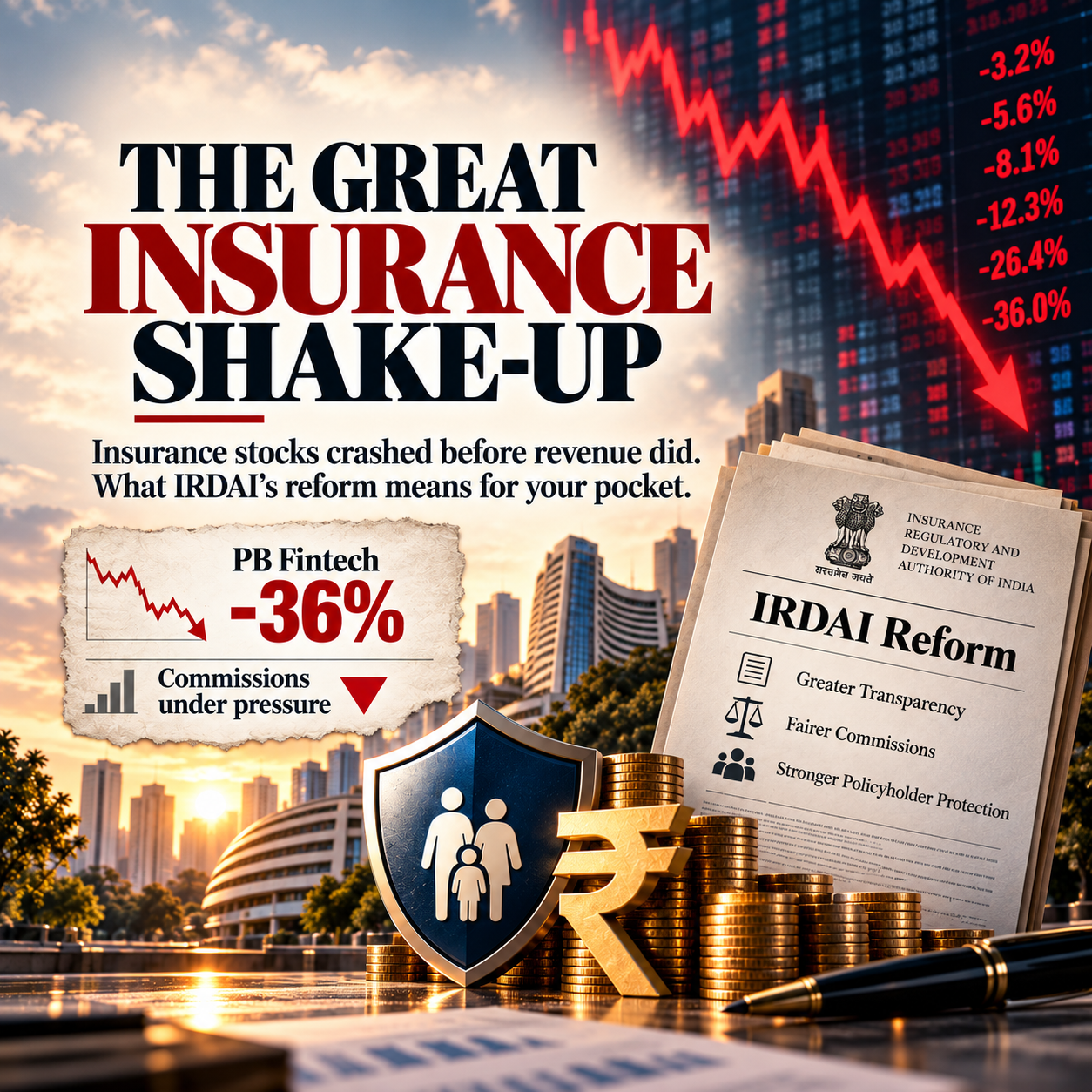
The Day Insurance Stocks Collapsed
On September 23, 2026, at 2:30 PM, the Insurance Regulatory and Development Authority of India (IRDAI) released a consultation paper that would send shockwaves through the insurance industry.
By market close on September 24, the damage was visible:
PB Fintech (Policybazaar) crashed 36% — losing ₹25,000 crore in market cap in a single day
Turtlemint Fintech fell sharply
Traditional insurers like HDFC Life, SBI Life, ICICI Prudential, and Max Financial all declined
Insurance stocks saw one of the worst single-day sell-offs in Indian market history
But here's the thing: not a single rupee of revenue was lost that day. No company announced lower earnings. No customer's policy was cancelled. Yet the stock market behaved as if the entire business model had imploded.
Why? Because investors instantly understood what the IRDAI was proposing would fundamentally change how money flows through the insurance industry — and who gets to keep it.
The Current Setup: How Insurance Money Actually Moves
Before diving into the reform, let's understand how the present system works. Imagine this scenario: You decide to buy a ₹20,000 annual health insurance premium for yourself. You don't walk into an insurance company office. You go to Policybazaar.com, compare plans, and buy online. Or maybe your bank suggests a policy during a loan application. Or a financial advisor recommends one.
Here's what happens to that ₹20,000:
The Customer Pays: ₹20,000 to the insurance company
The Insurance Company (e.g., HDFC Life) Receives: ₹20,000
Keeps for claims, operations, and profit: ~₹14,000–₹16,000
Pays commission to distributor: ~₹2,000–₹2,500 (roughly 10–12.5%)
The Distributor (Policybazaar) gets: ₹2,000–₹2,500
This is called the "take rate" — the percentage of premium the distributor keeps
From this, Policybazaar pays:
Technology costs
Customer acquisition (ads, marketing)
Customer service (call centres, support)
Employees
Server infrastructure
And tries to make a profit from what's left
Why is this arrangement profitable for Policybazaar?
Because it doesn't have to maintain:
Thousands of insurance agents
Office networks across India
Compliance teams (partially; it still has them, but fewer than insurers)
Claims processing infrastructure
Underwriting teams
It just sits in the middle, takes the commission, and scales technology to reach millions of customers for relatively low per-customer costs.
This is the business model that made Policybazaar valuable.
Now, let's see what the IRDAI wants to change.
What IRDAI Actually Proposed (The Detailed Version)
The IRDAI didn't wake up one morning and decide to kill insurance distribution. It released a consultation paper — which means the proposals are still being debated. The authority invited feedback until October 25, 2026. But here's what's on the table:
Proposal 1: Commission Caps
Current Scenario: Insurance companies pay distributors 10–15% of the first-year premium, depending on the product and channel.
IRDAI's Proposal: Cap commissions at lower levels and create a "glide path", meaning commissions would reduce gradually over 2–5 years.
For example, under the proposal:
First-year commission on life insurance: Could be capped at 6–7% (down from current 10–15%)
First-year commission on health insurance: Could be capped at 5–6% (down from current 8–12%)
Renewal commissions: Would be much lower
What does this mean?
If Policybazaar currently earns ₹2,500 per ₹20,000 policy (12.5%), under the new proposal it might earn only ₹1,200–₹1,500 per policy (6–7.5%).
That's a 40–50% cut in revenue per policy.
Proposal 2: Expense of Management (EoM) Limits
Current Scenario: Insurers can spend up to 30–40% of premiums collected on distribution, advertising, agent commissions, office costs, and admin expenses.
IRDAI's Proposal:
Life insurers: Reduce to 15% within 2 years, then 12.5% within 5 years
General insurers: Reduce to 20% within 5 years
This is a massive squeeze on how much insurers can spend to acquire customers.
What does this mean?
If HDFC Life collected ₹10,000 crore in premiums in a year, it currently might spend ₹3,000–₹4,000 crore on distribution and acquisition.
Under the new rules, it could spend only ₹1,250–₹1,500 crore.
Where does this money come from?
Fewer commissions to distributors, fewer ads, fewer agents.
Proposal 3: Dark Pattern Restrictions
Current Reality: Insurance websites often ask for personal details (name, email, phone) before showing you the actual price of a policy. Once you provide details, insurance companies call you repeatedly.
IRDAI's Proposal: Ban these "dark patterns" and require that pricing and key information be displayed without forcing customers to surrender personal data first.
What does this mean?
Insurance websites must show you the actual premium upfront
You can browse and compare without phone calls flooding in
The sales process becomes more transparent
For companies like Policybazaar that rely on collecting customer data to sell to insurers, this might reduce the lead quality they can generate.
The Practical Impact: Before and After the Reform
Let's walk through real scenarios to understand what changes.
Scenario 1: A 35-Year-Old Buys Term Insurance
BEFORE REFORM (September 24, 2026):
Step 1: Customer visits Policybazaar
Step 2: Sees a ₹500/month plan for ₹1 crore term insurance
Step 3: Enters name, phone, email
Step 4: Policybazaar's agent calls him immediately
Step 5: After some back-and-forth, the customer buys the plan for a ₹6,000/year premium
Step 6: Insurance company receives ₹6,000
Pays Policybazaar commission: ₹900–₹1,200 (15–20% for term insurance)
Keeps ₹4,800–₹5,100 for claims and operations
AFTER THE REFORM (IF FINALIZED):
Step 1: Customer visits Policybazaar
Step 2: Sees ₹500/month plan for ₹1 crore term insurance
Step 3: Sees the price immediately (no forced data collection)
Step 4: Can compare with other platforms without surrendering details
Step 5: If he buys, Policybazaar receives commission: ₹360–₹480 (6–8% for term insurance under proposal)
Insurance company keeps ₹5,520–₹5,640
The Shift:
Customer: Gets transparency (better experience)
Policybazaar: Loses ₹500–₹700 per policy sold (33–50% revenue cut)
Insurance company: Spends less on distribution overall, but must be smarter about customer acquisition
Scenario 2: A 45-Year-Old Buys Health Insurance
BEFORE REFORM:
Customer buys ₹5 lakh health insurance for ₹12,000/year. Insurance company breakdown:
Premium received: ₹12,000
Commission to distributor/broker: ₹1,200–₹1,800 (10–15%)
Claims payout potential: ~₹6,000–₹8,000 (insurance companies typically aim to spend 60–70% of premiums on claims)
Admin, acquisition, profit: ₹2,000–₹4,000
AFTER THE REFORM:
Same customer, same policy, same ₹12,000 premium. Insurance company breakdown (proposal):
Premium received: ₹12,000
Commission to distributor: ₹600–₹900 (5–7.5% under proposal)
Claims payout potential: ~₹6,000–₹8,000 (still similar)
Admin, acquisition, profit: ₹3,100–₹5,400
Does this look better for the insurance company?
Not really. Here's why: The ₹600–₹900 commission is only the direct commission. Under current rules, the EoM limit of 40% means insurers can spend money on:
Their own advertising
Their own agents
Call centers
Technology
Admin overhead
If the EoM limit drops to 12.5% (life) or 20% (health), insurers can't make up for lower commissions by spending more elsewhere. They have to reduce total distribution spending.
The Real Impact: Fewer insurance policies will be sold overall (because there's less money to push them), or premiums will rise.
Who Gets Hurt? Who Benefits?
Losers Under the Reform:
1. Policybazaar and Turtlemint (Fintech Distributors)
Direct commission income drops 40–50%
Customer acquisition costs don't drop proportionally
Profitability gets squeezed
Business model faces existential pressure
2. Traditional Insurance Agents
Commission income likely to drop
Fewer agents will be hired
Some agents may lose jobs
3. Insurance Companies (short-term)
Must cut distribution spending significantly
Customer acquisition becomes harder
Revenue growth may slow
Profitability pressured in the short term
Winners Under the Reform:
1. Customers (In Theory)
Lower premiums (because distribution costs drop)
More transparent pricing
Less aggressive selling tactics
Clearer policy information
2. Insurance Customers Long-Term
If claims experience improves (because companies focus less on acquisition and more on claims)
If competition increases (lower barriers for new entrants without big distribution networks)
3. New Digital-First Insurance Startups
They don't have legacy agent networks to maintain
They can operate leaner from day one
The playing field levels out
The Real Story: Cost Efficiency Vs. Growth
Here's the uncomfortable truth that the market understands
Insurance distribution is expensive.
Right now, to sell 1 million policies, the industry collectively spends ₹500–₹1,000 crore on commissions, ads, and agents.
Under the IRDAI proposal, they'd spend ₹250–₹400 crore. This saves money, sure. But it also means:
Fewer policies are sold
Insurance penetration may actually decrease
The industry grows more slowly
For Policybazaar: It's surviving on the volume of cheap policies sold. Cut commissions by 50%, and suddenly the volume needs to triple just to maintain revenue. Tripling volume with half the commission per sale is extremely hard.
For Insurance Companies: They benefit long-term (lower costs, better profitability per policy). But short-term growth suffers.
For Customers: They should win — lower distribution costs should translate to lower premiums. But only if competition remains intense and companies don't just pocket the savings.
What Happens Now? (The Timeline)
This is crucial: The proposals are NOT law yet.
Key Dates:
September 23, 2026: IRDAI releases consultation paper
October 25, 2026: Deadline for stakeholder feedback
October–November 2026: IRDAI reviews feedback
Late 2026 or Early 2027: IRDAI likely releases final regulations (may differ from proposals)
Implementation: Likely phased over 2–5 years (not overnight)
What could change before finalisation?
Commission caps may be slightly higher
EoM limits may be adjusted
Dark pattern rules may be clarified
Renewal commissions may get better treatment
Rural and protection policies may get exemptions
Why? Because insurance companies, banks, and brokers will fight back hard during the consultation period. They'll argue that lower commissions hurt rural insurance, that customer acquisition becomes impossible, that innovation stops.
And they have valid points.
A Practical Example: What Your Next Insurance Policy Might Look Like
Let’s say you're buying health insurance in early 2027 (if reforms are finalised by then)
What changes for you (the customer):
Pricing is clearer upfront — You can see the exact premium without giving your phone number
Fewer sales calls — Because companies can't aggressively push leads to agents
Potentially lower premiums — Distribution costs drop, so insurers may lower prices to compete
Less aggressive cross-selling — No pressure to buy additional products at the last minute
More comparison shopping — You can actually compare across multiple platforms without your phone ringing off the hook
What doesn't change:
Claims process (mostly the same, though faster settlement timelines are separate IRDAI rules)
Coverage quality (regulations on what must be covered remain the same)
Premium calculation (still based on age, health, occupation)
What might get worse:
Fewer awareness campaigns (less marketing = less education about insurance)
Fewer insurance policies sold overall (fewer people buy because there's less aggressive promotion)
Rural insurance might suffer (less profitable, so insurers focus less on rural areas)
Why IRDAI Did This? The Bigger Picture behind this:
The regulator isn't trying to destroy insurance distribution. It's trying to fix a problem:
The Problem: Insurance distribution has become about sales volume, not customer protection.
Companies spend massive amounts of money to collect leads
Agents push products that may not suit the customer
Dark patterns trick people into surrendering data
Renewal commissions are high, incentivising mis-selling
Customers get confused between plans and make wrong choices
IRDAI's Logic: If we reduce the money incentive to push policies, the industry will focus on:
Keeping existing customers happy (not chasing new ones aggressively)
Reducing mis-selling
Improving claims service
Making products simpler and clearer
Long-term: This should create a more mature insurance market, not a smaller one.
What Should You Do Right Now?
If You're a Consumer:
Buy insurance now if you need it — don't wait for prices to drop (they may not, given transition costs)
Use fintech platforms while they're offering aggressive commissions (better deals)
Read policy terms carefully — dark pattern restrictions will help, but you must still be diligent
If You're a Policybazaar/Insurance Stock Investor:
The current crash is likely overblown (final rules could be softer)
But profitability pressure is real — don't expect 2024 margins in 2028
Watch October 25 closely for feedback from industry bodies
Final implementation is likely 2–5 years away (not immediate)
If You're in the Insurance Industry:
Start thinking about how to operate with 40–50% lower distribution budgets
Invest in tech to reduce costs (automation, digital first)
Build brand loyalty (less spending on acquisition = focus on retention)
Explore underwriting profit (sell fewer policies, but make sure each one is profitable)
The Bottom Line
On September 23, 2026, IRDAI proposed reforms that would fundamentally reshape how insurance is distributed in India.
For the industry: Painful short-term, potentially healthier long-term.
For customers: Theoretically better (more transparency, potentially lower premiums), but depends on execution.
For investors: The crash was justified, but likely overextended. October 25 will be crucial — if final rules are softer, stocks could rebound significantly.
For society: If done right, this creates an insurance market focused on serving customers, not farming commissions.
The regulation isn't finalised yet. The debate is just starting. And Indian insurance, for better or worse, is about to change.
What do you think? Will these reforms improve insurance for customers, or kill the industry's growth? Share your thoughts in the comments.
Disclaimer: This article is for educational purposes and reflects the regulatory proposals as of September 24, 2026. Final regulations may differ. This is not investment advice. Consult a financial advisor before making decisions based on these reforms.
Absolute Analytics
From Chaos to Clarity