
The Trade Nobody's Talking About
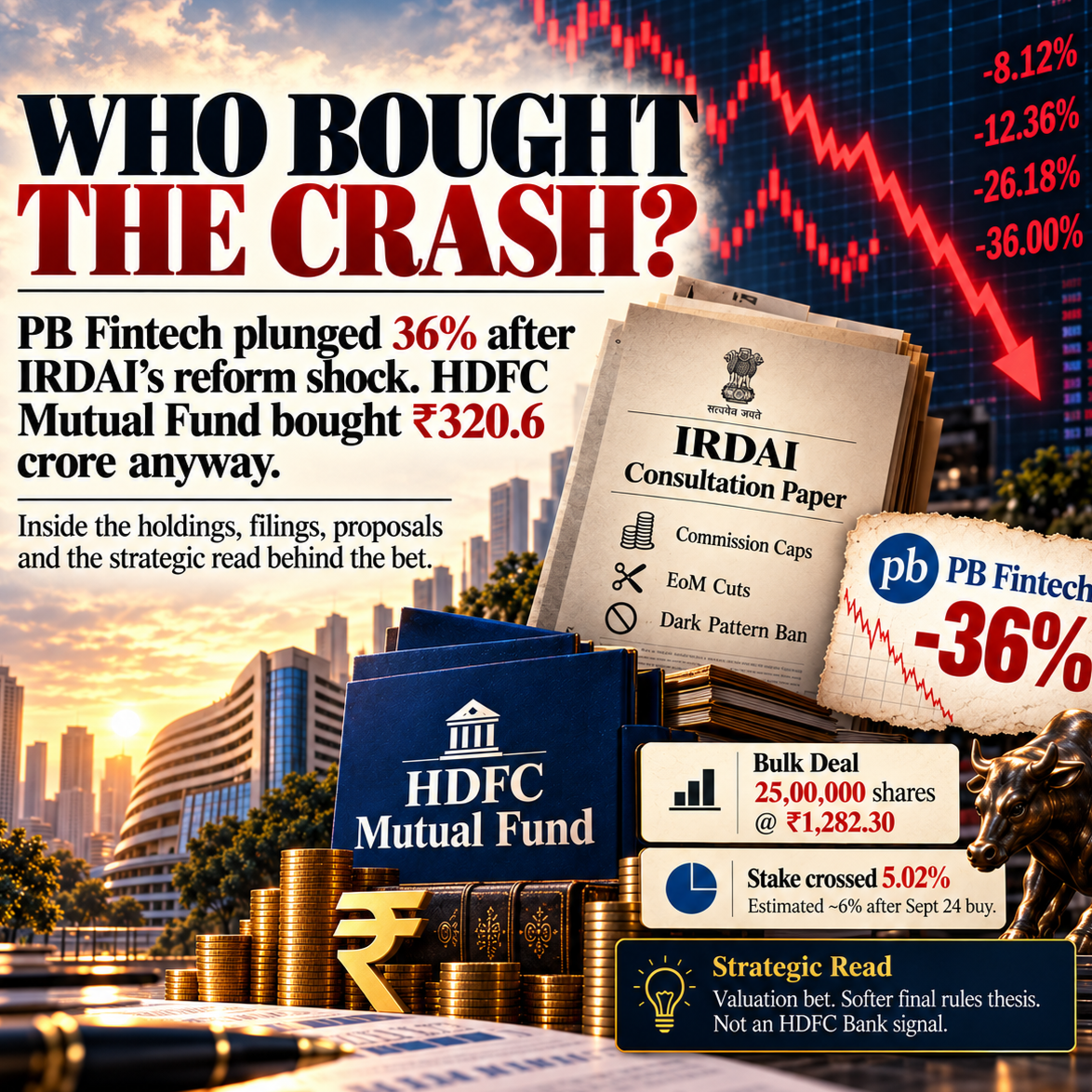
September 24, 2026, Policybazaar was in free fall. It was down 36%. Whatever you want to say: panic selling, margin calls. Everyone's just dumping it.
Then HDFC Mutual Fund walks in and buys 25 lakh shares—in a single session—at ₹1,282 per share. ₹320 crores in one day, that too on the worst day for the stock.
The rumours spread: “Group coordination. HDFC Bank protecting HDFC Life, protecting HDFC Mutual Fund. All connected. All rigged.”
Wrong! That was the surface story.
The real story is smarter, and more important for how you think about this stock.
What HDFC MF Actually Owns (Before and After)
HDFC Mutual Fund's largest PB Fintech holdings sit in two portfolios:
HDFC Mid Cap Fund: 97.84 lakh shares (flagship active-management fund)
HDFC Flexi Cap Fund: 91.85 lakh shares (conviction-driven portfolio)
These aren't passive holdings. These are actively managed funds where stock pickers sit down every morning and decide whether to hold, buy, or sell based on valuation.
Before September 23, HDFC MF was already at 5%+ equity (hitting the SAST disclosure threshold in July). They'd built the position at ₹1,700–1,900 per share, back when insurance distribution looked like a stable, high-margin play.
Then the IRDAI drops the bomb, and the stock drops 36%. Most funds would sit tight, hoping to preserve capital.
HDFC MF did the opposite: it doubled down.
The Real Play is About Math.
Here's what the numbers tell you about HDFC MF's thinking:
Before Sept 24:
Holdings of approx. 500 lakh shares at ₹1,700–1,900 average
Loss on paper: approx. ₹210–1,050 crore, depending on entry price
The problem: Sitting on underwater positions
After Sept 24:
Bought another 25 lakh shares at ₹1,282
New position of ~525 lakh shares
Blended cost basis of approx ~₹1,500–1,600 (rough math)
Upside projections at ₹1,540 (Jefferies target): 3–5% from the new average
Here's why this matters: When a stock falls 36% in a day, there are only two kinds of buyers:
Panic buyers (buy anything to feel like they're doing something)
Disciplined value buyers (buy at specific prices with thesis-based targets)
HDFC MF is the second type. They're saying: "At ₹1,282, the risk-reward swings our way." That's not hope. That's pure arithmetic.
Main Ques is: Why HDFC MF Thinks ₹1,282 Is a Floor (Not Final)
The thesis behind this buy, pieced together from management commentary and the paper itself. Look at the main points here:
FY27 is a safety year.
IRDAI's changes don't apply until FY28. That means there are 6+ months of earnings visibility under the old rules. The market's pricing in the worst case immediately. HDFC MF is betting the stock stays afloat on FY27 results before the pain hits.
FY28 is painful but survivable.
Health and motor margins get crushed (maybe 30–50% hit to those divisions)
Life margins stay roughly flat (renewals = higher commissions = better resilience)
Revenue impact: 20–30% worst case, offset partially by volume elasticity
Management's own words: "No mass layoffs. Slower hiring. Cost reassessment." That's an assurance that loyal customers still exist.
FY29+ is recovery.
The business stabilises at a new, lower-margin equilibrium
At scale, lower commissions still work if your technology is cheap
New revenue streams (MGA services, servicing monetisation, maybe insurance partnerships)
Volume growth from lower customer acquisition costs
At ₹1,282, you're pricing in permanent damage. HDFC MF is pricing in a difficult patch, then comes the recovery. That's the real bet.
Reading Between the Lines
Buying 25 lakh shares (~0.54% of equity) in one session on a 36% crash day isn't casual. Why that move tells you something:
Liquidity commitment. When a stock falls 36%, the bid-ask spread widens. Sellers overwhelm buyers. You have to have size to show up and actually get filled. HDFC MF didn't just place a limit order and hope; they executed with conviction.
Price stabilisation. A ₹320 crore buy on a falling knife actually helps hold the floor. Thats purely logical and technical! It removes supply anxiety from sellers. The stock bottomed at ₹1,115; HDFC MF's buys at ₹1,282 were well above that, signalling "there's a buyer here, repeatedly."
Portfolio math. If your blended cost is ₹1,750 and the stock falls to ₹1,200, you're down 32% on that tranche. But if you add at ₹1,282, your blended average falls to ₹1,500–1,550. Now a recovery to ₹1,500–1,600 (as per Jefferies' range) isn't chasing a dream. It is a mean reversion. HDFC MF isn't betting on the moon. It's betting on the math working.
Here's Why You're Wrong About The Buying.
The minute HDFC MF bought, social media lit up with conspiracy theories: Group coordination. Insider dealing. HDFC protecting its own.
Three things kill that narrative:
1. HDFC Group members have conflicting interests.
HDFC Bank loses fee income from lower commissions. The bank is itself a distributor. Lower insurance commissions mean lower bank revenue. Would HDFC Bank really coordinate to save a company that hurts its own business? No.
HDFC Life gains medium-term from lower acquisition costs (lower commissions mean lower cost of customer acquisition). But in the short term, lower premium volumes and EoM limits hurt it.
HDFC Mutual Fund has zero operational exposure to insurance. It's a pure financial investor. Its only incentive is portfolio returns.
If this were coordinated, you'd expect public statements. Joint partnerships. Maybe even HDFC Life buying back insurance policies from Policybazaar. Instead: crickets.
Remember: HDFC Life's stock fell 8.46% on Sept 24. If the group was protecting it, the stock wouldn't have crashed.
2. The legal reality.
SEBI rules are clear: HDFC AMC's investment decisions must be independent of its sponsor. Conflicts exist, but you can't act on them. A fund manager has fiduciary duties to unit holders, not to the sponsor group. If HDFC MF bought to protect HDFC Bank or HDFC Life rather than because the valuation was compelling, that would be a breach of duty. Potentially recoverable from the fund. No responsible fund manager does that.
3. Expect silence.
When groups coordinate, they communicate. Through press releases, analyst call comments, subtle hints in quarterly results. HDFC has done nothing. No "strategic support" statements means no "group confidence" announcements. The group has stayed silent, which is exactly what you'd expect if a fund manager made an independent call, not a coordinated one.
What This Buy Actually Signals
Strip away the conspiracy thinking, and HDFC MF's buy tells you something concrete:
1. Management's thesis is credible (to them).
HDFC MF manages ₹4+ lakh crore in assets. They employ serious stock pickers who read earnings models and talk to management teams. If they're buying 25 lakh shares, they're not guessing. They're saying: "We've modelled this. The recovery is real."
2. The floor is probably real.
The market fell to ₹1,115. HDFC MF stopped buying at ₹1,282. If they thought it could fall to ₹500, they would've waited. By buying at ₹1,282, they're tacitly saying: "Below this, the risk-reward inverts."
3. Timeline matters.
This isn't a bet on immediate recovery. HDFC MF is playing FY28–29. That's 18–24 months of patience. If you're a trader looking for a bounce next quarter, this isn't your signal. If you're positioning for regulation to soften, or for FY28 margin compression to be survivable, this is interesting.
4. October 25 is a non-event (for this thesis).
HDFC MF isn't betting on IRDAI softening the rules. It's betting that even if the rules stick as proposed, Policybazaar survives it. The comment deadline is 34 days away. HDFC MF's buying on Sept 24 says: "We don't need a reprieve. We just need management to execute FY28."
The Assumptions Built Into This Trade
Every large institutional buy is an implicit confidence statement. Reading between the lines, HDFC MF is betting on:
Management credibility. Yashish Dahiya and team have the experience and capital discipline to navigate this. The CEO said FY27–28 are survivable. HDFC MF believes him.
Technology moat. In a world of lower margins, scale and technology matter. Policybazaar's platform is the lowest-cost, most transparent distribution channel in India. That moat survives regulation.
The paper won't torpedo the company. Yes, commissions get cut. But credit-life (the real killer) is only 5% of business. Health and motor pain are real, but life compensates. EoM limits kick in gradually.
Volume elasticity. If insurance is cheaper, more Indians buy it. Policybazaar captures some of that growth. The company doesn't need to maintain premium market share—it just needs customer share.
Worst-case is priced. At ₹1,200, you're pricing in a 50% permanent loss to the business. HDFC MF is betting on a 25–30% loss, not 50%.
What it's NOT betting on:
-Rules get reversed (unlikely)
-IRDAI goes softer (possible, but not the bet)
-Immediate bounce to ₹1,500 (that's a symptom, not the thesis)
-Group protection (not how this works)
So What Does This Mean for You? (Reason you made it so far)
If you're watching Policybazaar, here's what the HDFC MF trade tells you:
For traders: The Sept 24 crash likely found a floor. HDFC MF's conviction buying suggests ₹1,100–1,200 is oversold. A bounce to ₹1,400–1,500 is plausible in the short term. But this isn't an "all clear" signal—it's a "there's buying at these levels" signal. Two different things.
For investors: The real timeline is FY28–29. If you believe Policybazaar survives regulation and delivers FY29 recovery, HDFC MF's thesis applies to you. If you think the company faces structural decline, no amount of HDFC MF buying saves it. The trade depends on where you stand on the business thesis.
For understanding regulation: HDFC MF's willingness to buy despite the paper (not because of softening hopes) suggests they think the business model survives the rules. They're not betting on regulatory reversal. They're betting on adaptation.
The Uncomfortable Truth
Here's what you're not hearing from sell-side analysts or media:
HDFC MF bought because Policybazaar, at ₹1,282, was cheap relative to management's recovery thesis. Not because the group coordinated. Not because they have insider information. Not because the rules will be soft.
Just because the math, at that price, worked. That's boring. But it's how sophisticated capital actually moves.
The story isn't "HDFC Group Backs Its Own." It's "Fund Manager Buys Stock They Think is Underpriced." That second story doesn't sell subscriptions or ad space, so you won't hear it on financial TV.
But if you want to understand how professional money thinks when retail is emotional, this is the playbook: Buy when the crowd is selling, but only if the math survives the worst case.
HDFC MF's ₹320 crore bet says: Worst case is priced. Policybazaar survives. The recovery is real.
Whether they're right is another question. But at least now you know what question they're answering.
Key Signals (One-Line Takeaways)
₹320 crore buy on Sept 24 = HDFC MF sees floor at ₹1,282
Not group coordination; just an independent fund manager valuation call
Blended cost basis now ₹1,500–1,600 (downside cushion)
FY27 safe, FY28 painful, FY29 recovery is the thesis
October 25 regulatory deadline is a non-event for this play (HDFC isn't betting on softening)
At ₹1,282, worst-case is priced; recovery upside begins here
Timeline: 18–24 months minimum; not a short-term trade